
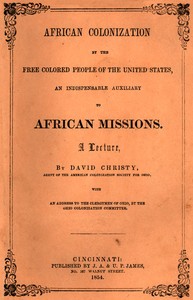
African Colonization by the Free Colored People of the United States, an…
Let's be clear from the start: this isn't a storybook. Published in 1854, David Christy's work is a political and moral argument. It's a detailed blueprint for a movement that was very real in its time.
The Story
There's no protagonist or villain in the traditional sense. The 'story' is Christy making his case. He lays out the situation of free Black Americans in the 1850s, describing the prejudice and legal restrictions they faced. He then presents colonization—the organized emigration of free Black people to West Africa—as the only peaceful and practical solution. The book is packed with his reasoning: it would remove racial tension, spread Christianity and civilization in Africa, and give Black Americans a chance at true citizenship elsewhere. He discusses the American Colonization Society's efforts, the founding of Liberia, and includes maps and population data to support his vision. The entire book is a passionate plea for this policy, framed as a benefit for all involved.
Why You Should Read It
Reading this is a powerful exercise in historical empathy, and I don't mean agreeing with it. It's about understanding a worldview that feels alien and wrong today. Christy wasn't a cartoon villain; he believed he was promoting a moral, gradualist solution. That's what's so gripping and unsettling. You get inside the head of a mainstream 19th-century reformer and see how even 'well-intentioned' ideas could be deeply oppressive. It also throws into sharp relief the courage and conviction of abolitionists who fought for integration and equality within America, against proposals like Christy's. This book doesn't just tell you history; it makes you feel the weight of the arguments that shaped it.
Final Verdict
This is not for casual readers looking for a narrative. It's perfect for history buffs, students of American race relations, or anyone who wants to go beyond simplified history. If you've read narratives about slavery and abolition, this primary source shows you a major ideological battle of the era from the inside. Be prepared for dense, old-fashioned prose and arguments that will make you cringe. But if you can sit with that discomfort, you'll come away with a much richer, more complicated understanding of a critical period in American history.
This masterpiece is free from copyright limitations. You are welcome to share this with anyone.
George Brown
10 months agoI was particularly interested in the case studies mentioned here, the emphasis on ethics and sustainability within the topic is commendable. This is a solid reference for both beginners and experts.
Sarah Rodriguez
2 years agoBefore I started my latest project, I read this and the structural organization allows for quick referencing of key points. If you want to master this topic, start right here.
Joseph Martinez
4 months agoLooking at the bibliography alone, the logic behind each conclusion is easy to follow and verify. This adds significant depth to my understanding of the field.
Donald Smith
1 month agoUnlike many other resources I've purchased before, the language used is precise without being overly academic or confusing. This exceeded my expectations in almost every way.




Nancy Brown
1 year agoAs a professional in this niche, it addresses the common misconceptions in a very professional manner. Highly recommended for those seeking credible information.