1

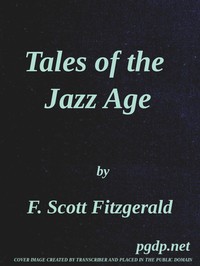
Tales of the Jazz Age — Themes and Context
(0 User reviews)
523
Project Gutenberg
2004
Not confirmed
Short stories; United States -- Social life and customs -- 20th century -- Fiction
Readers of public-domain and historical texts
Project Gutenberg digital edition
en
Edition facts
Words
93,274
Reading time
406 min
Text sections
15
For Tales of the Jazz Age — Themes and Context, the stored edition analysis reports 93,274 words, 6 hr 46 min estimated reading time, and 15 detected text sections.
The text analysis averages about 14.9 words per sentence, while the detected sections provide another way to judge how the source is divided.
Project Gutenberg metadata also associates the work with “Short stories,” connecting these edition facts with the source record’s subject description.
Source:
Project Gutenberg record #6695
Fitzgerald's 1922 collection mixes Southern stories, New York hysteria, and fantastical satire. The author's own introductions reveal the stories' origins—a craps game written with his wife, a camel costume from real life, and an attempt to weave three unrelated events into a pattern capturing the Jazz Age's 'general hysteria.'
Editorial Edition Score
4.8/5
★★★★★
★★★★★
Calculated from edition completeness, EPUB availability, text structure and catalogue metadata. Not a user rating.
How this score is calculated
- Description quality20 pts
- Title & short description10 pts
- Source metadata20 pts
- Text length15 pts
- Chapters / structure15 pts
- EPUB file integrity20 pts
Total of 100 points, scaled to a 2.5-5.0 range. Editions with an empty description or a missing EPUB file are not scored.
Edition quality
Public-domain source text
Read the source text
The source text is kept in the dedicated reader, separate from this catalogue record and its commentary.
Fitzgerald prefaces each story in Tales of the Jazz Age with a brief, often wry account of its composition. These headnotes are as revealing as the fiction itself: he admits that “The Camel’s Back” was written in a single day to buy a diamond wristwatch, that his wife collaborated on the crap-shooting episode in “The Jelly-Bean,” and that “May Day” tries—unsuccessfully, he fears—to weave three unrelated events into a pattern capturing the “general hysteria” of spring 1919. The collection thus offers a dual reading experience: the stories themselves, and the author’s candid, sometimes self-deprecating commentary on their making.
Collaboration and Craft in the Headnotes
Fitzgerald’s prefaces turn the volume into a kind of meta-narrative. In “The Jelly-Bean,” he notes that he could not manage the crap-shooting scene and handed it to his wife, “who, as a Southern girl, was presumably an expert.” This admission not only reveals a specific compositional division but also hints at the gendered expectations of regional authenticity. For “The Camel’s Back,” he claims the camel costume episode is “literally true” and that he has a standing engagement to play the hindquarters at a future party—a joke that blurs the line between life and fiction. These headnotes invite readers to consider how much of each story is invented and how much is repurposed autobiography.
Regional Voices and the Southern Setting
The opening story, “The Jelly-Bean,” is set in Tarleton, Georgia, a place Fitzgerald says he has “a profound affection for” but that draws angry letters from Southern readers. The excerpt does not include the story itself, but the headnote establishes a tension between affectionate portrayal and regional criticism. The author’s wife, as a Southern girl, was called in to supply authentic crap-shooting terminology, suggesting that the story’s local color was carefully researched. This concern for linguistic and cultural accuracy—even in a pastime—marks Fitzgerald’s effort to render a specific Southern milieu, even as he anticipates pushback from its natives.
Patterns of Hysteria and Confinement
In the excerpt from “The Diamond as Big as the Ritz,” a captive aviators’ pit becomes a grotesque microcosm of American greed and power. Braddock Washington, the captor, dismisses the prisoners’ pleas with cold logic: “Cruelty doesn’t exist where self-preservation is involved.” The scene is structured as a dialogue of unequal power, with Washington seated in a garden chair above the grating while the men shout up curses and desperate jokes. The setting—a polished glass bowl in the earth—echoes the “general hysteria” Fitzgerald names in the “May Day” headnote, but here the hysteria is contained, literally underground, and met with the unruffled composure of the ultra-wealthy.
Readers approaching Tales of the Jazz Age will find that Fitzgerald’s own introductions provide a valuable key to the stories’ tones and origins. Pay attention to the gaps between his self-deprecating claims and the finished fiction—the admitted failures, the borrowed expertise, the real-life anecdotes. These headnotes do not simply introduce; they frame the stories as experiments in voice, region, and structure, inviting the reader to judge how well the patterns hold together.
Fitzgerald’s note about that camel costume made me recall my uncle’s moth-eaten St. Patrick’s getup, half-remembered as magic. His introductions feel like someone handing you a photo album, not a lecture. The same quiet pull came from Stories by American Authors (Volume 4) — Story, Setting & Ideas, where the setting itself seemed to breathe. Both books didn’t explain the era; they just held it, loosely, like a familiar coat.
There are no reviews for this eBook.
There are no comments for this eBook.
Reader reflection
How will you remember this book?
Save your reaction, strongest insight, and memorable passage.
Your progress
0
/
10
2
What was your overall reaction to the book?
3
Would you pass this book on to a friend?
4
What was the reading difficulty like?
5
Is this a title worth rereading?
6
How much did the book move you?
7
Would you like to discuss this book with someone?
8
Which aspect of the book did you value most?
9
In one sentence, what did you learn?
10