1

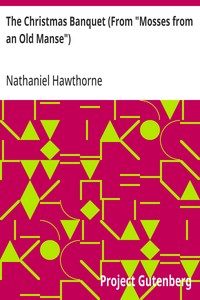
The Christmas Banquet (From "Mosses from an Old Manse") — Context and Discussion
3
1
Project Gutenberg
2005
Short stories; New England -- Social life and customs -- Fiction
Readers of public-domain and historical texts
Project Gutenberg digital edition
en
Edition facts
Words: 10,241
Reading time: 45 min
Text sections: 2
Source:
Project Gutenberg record #9228
Hawthorne's story frames a Christmas banquet for the ten most miserable persons, where the recurring guest Gervayse Hastings—prosperous yet emotionally hollow—embodies a chilling paradox: a life of external success that feels like 'a mere vapor.' The tale probes the nature of true misery versus spiritual emptiness.
Editorial Edition Score
4.5/5
★★★★★
★★★★★
Calculated from edition completeness, EPUB availability, text structure and catalogue metadata. Not a user rating.
Edition quality
Hawthorne frames his tale through a framing device: Roderick, a character who claims to have 'wandered like one astray in a dark cavern' into the 'gloomy mysteries of the human heart,' reads a manuscript to his wife Rosina and a sculptor. This layered narration immediately signals that the story will be an allegorical inquiry into a specific kind of human deficiency—one that Roderick describes as a 'cold unreality,' a person who is 'chill and unsubstantial,—a mere vapor.' The Christmas Banquet itself is a bequest from a melancholy eccentric, designed not to cheer the miserable but to preserve a 'stern or fierce expression of human discontent' against the holiday's universal joy.
The Banquet's Peculiar Purpose
The testator's will establishes a fund for an annual Christmas banquet for 'ten of the most miserable persons that could be found.' The intent is explicitly not to make them merry, but to ensure that 'the stern or fierce expression of human discontent should not be drowned' amid the festive gratitude of Christendom. This inversion of Christmas charity—a feast that honors misery rather than alleviating it—sets up a stark contrast between outward celebration and inner desolation. The banquet becomes a ritualized space where society's hidden griefs are displayed, yet the narrative quickly complicates the notion of who truly belongs there.
Gervayse Hastings: The Impassive Enigma
Among the guests, Gervayse Hastings stands out as the only 'invariably present' figure, yet his presence provokes murmurs: 'Who is this impassive man? Has he suffered? Has he sinned?' He is described as wealthy, brilliant, and successful—possessing a 'lovely and tender wife' and 'children of fair promise'—yet his associates find him 'cold,' a 'marble statue' who inspires 'distrustful regret.' The narrative emphasizes that his life is not merely prosperous but 'brilliant,' and that he has sought happiness 'not vainly.' Nevertheless, those who try to know him 'shrink back' as if grasping 'the hand of a shadow upon the wall.' This paradox—a man who has everything yet feels like nothing—becomes the story's central puzzle.
The Shadow Among the Miserable
Hastings's inclusion at the banquet raises the question of what qualifies as true misery. The other guests include 'the exiled noble of the French Revolution,' 'the broken soldier of the Empire,' and even Aaron Burr in his 'lonely age'—figures whose calamities are visible and historically legible. Yet Hastings, who has suffered no such reversals, attends year after year, his face changing 'from smooth beauty to thoughtful comeliness' and then to 'bald, impressive dignity.' The text suggests that his deficiency is spiritual: a 'lack of the last inestimable touch of a divine Creator.' Roderick's preface hints that such a man, if conscious of his own hollowness, would 'go shivering through the world, longing to exchange his load of ice for any burden of real grief.' The banquet thus becomes a stage where external misfortune and internal emptiness are juxtaposed, leaving the reader to weigh which is more profound.
Patterns of Contrast and Recurrence
Hawthorne builds the story on repeated contrasts: the festive Christmas setting versus the grim purpose of the banquet; the visible grief of historical figures versus the invisible void of Hastings; the warmth of human connection versus the 'cold abstraction' of a man who cannot respond to 'the demands that spirit makes upon spirit.' The narrative also employs a pattern of recurrence—Hastings appears at every banquet, aging but unchanged in his essential nature. This repetition underscores the idea that his condition is not a temporary misfortune but a permanent state of being. The text invites readers to observe how these contrasts accumulate, creating a layered meditation on the nature of human suffering and the limits of external judgment.
Readers attentive to Hawthorne's allegorical method will note that the story never resolves whether Hastings's emptiness is a form of misery or its opposite. The banquet's annual recurrence and the guests' shifting identities suggest that the definition of 'most miserable' is itself unstable. Pay particular attention to the framing conversation between Roderick, Rosina, and the sculptor—it establishes the terms of the inquiry without dictating the answer. The tale rewards a slow reading that tracks how each detail about Hastings's life is undercut by the reactions of those around him.
Reader reflection
What did you think of this book?
Answer a few questions and save a private reflection on this device.
Your progress
0
/
10
2
What was your overall reaction to the book?
3
Would you pass this book on to a friend?
4
How demanding did the text feel?
5
How closely did the book connect with your experience?
6
How useful did the reading feel?
7
Which aspect of the book did you value most?
8
Was the book what you thought it would be?
9
In one sentence, what did you learn?
10