1

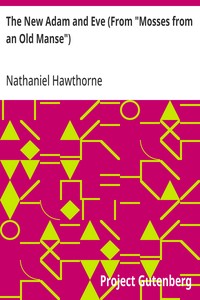
The New Adam and Eve (From "Mosses from an Old Manse") — Background and Themes
4
1
Project Gutenberg
2005
Short stories; New England -- Social life and customs -- Fiction
Readers of public-domain and historical texts
Project Gutenberg digital edition
en
Edition facts
Words: 9,957
Reading time: 44 min
Text sections: 2
Source:
Project Gutenberg record #9227
Hawthorne imagines a new Adam and Eve awakening in a deserted modern city, using their untutored perceptions to expose the artificiality of human systems—from banks to churches—in a playful yet pointed satire.
Editorial Edition Score
4.5/5
★★★★★
★★★★★
Calculated from edition completeness, EPUB availability, text structure and catalogue metadata. Not a user rating.
Edition quality
Hawthorne begins not with a garden but with a city emptied of humanity, a premise he calls “half sportive and half thoughtful.” The new Adam and Eve, created after the Day of Doom, possess “full development of mind and heart” yet no inherited knowledge of human customs. This allows Hawthorne to stage a series of encounters—with a bank, a jeweler’s shop, a church—in which the pair’s instinctive responses reveal the strangeness of what we call civilization. The narrator’s tone shifts between wry observation and philosophical reflection, as when Adam and Eve toss gold coins “sportively into the air” or mistake a diamond brooch for mere decoration. The result is a fable that uses innocence as a lens to critique the “elaborate perversities” of art, commerce, and religion.
Innocence as a Critical Lens
Hawthorne’s narrative device—a pair of unfallen adults—allows him to question what is “natural” versus what is merely “interpolation of the perverted mind and heart of man.” The new Adam and Eve do not reason from precedent; they rely on “instincts and intuitions.” When they enter a bank, they see only “heaps of rubbish” and “glittering worthlessness,” unaware that gold once held “magic spell, potent to sway men’s hearts.” Their bewilderment becomes a running joke: Adam wonders if collecting such rubbish might be “our business in the world,” while Eve counters that it would be better to “sit down quietly and look upward to the sky.” Through these exchanges, Hawthorne exposes the arbitrary value systems that govern human society, suggesting that much of what we call progress is merely elaborate artifice.
The Language of Objects and Spaces
Hawthorne invests physical objects with symbolic weight, letting the pair’s reactions do the work of social critique. In the jeweler’s shop, Adam adorns Eve with pearls and a diamond brooch, but she soon discards them for a bouquet of roses, finding the flowers “lovelier gems of nature” that “charm her with sentiment as well as beauty.” The contrast is pointed: manufactured wealth is hollow, while natural beauty carries emotional resonance. Similarly, the bank vault is described as “a magician’s cave when the all-powerful wand is broken,” its contents reduced to “fragments of shattered spells.” Hawthorne’s diction—words like “talismanic,” “ghosts of money,” “shadows of a shade”—reinforces the idea that human systems are a kind of sorcery, potent only as long as we believe in them.
Dialogue as Revelation of Character
The exchanges between Adam and Eve are brief but telling. Adam tends toward logical inquiry, trying to make sense of the artifacts they encounter: “Somebody, I am convinced, has taken pains to collect them, but for what purpose?” Eve, by contrast, responds with intuitive simplicity, preferring direct experience over analysis. When she remarks of the roses, “Surely they are living beings,” Adam agrees: “they seem to be as little at home in the world as ourselves.” This moment of shared wonder hints at their own alienation. Their dialogue never descends into sentimentality; instead, it reveals two distinct modes of perception—one analytical, one receptive—that together form a complete human response to a world they did not make.
The Unfinished Judgment
Hawthorne’s narrator explicitly states that the pair are “commissioned to pass unconscious judgment upon the works and ways of the vanished race.” Yet the judgment remains partial. The excerpts show Adam and Eve visiting a bank and a jeweler’s shop, but the full story likely extends to other institutions—churches, courts, homes. The narrator notes that “we must not attempt to follow every footstep,” leaving the reader to infer that the pair’s education is ongoing. What is clear is that Hawthorne uses their innocence not to advocate a return to nature, but to highlight the gap between human systems and human needs. The pair’s puzzlement is a mirror held up to the reader, asking us to reconsider what we take for granted.
Hawthorne’s fable resists easy moralizing. The new Adam and Eve are not reformers; they are simply observers, and their observations are filtered through a narrator who remains aware of his own complicity in the “artificial system.” Readers should attend to the tension between the playful surface and the serious critique beneath. The story rewards attention to its small details—the way a pearl is weighed against a rose, the way a bank vault becomes a magician’s cave—for it is in these moments that Hawthorne’s satire cuts deepest.
Reader reflection
How will you remember this book?
Save your reaction, strongest insight, and memorable passage.
Your progress
0
/
10
2
Did this book hold your interest?
3
Would you pass this book on to a friend?
4
How easy was the book to follow?
5
How well did it match your expectations?
6
Do you expect to return to this book?
7
Would you start a conversation about this book?
8
How clearly were the main ideas presented?
9
In one sentence, what did you learn?
10