1

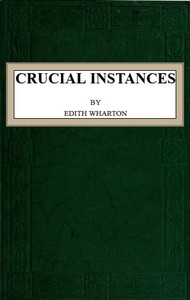
Crucial Instances — Background and Themes
(0 User reviews)
90
Project Gutenberg
2005
Not confirmed
Short stories, American; American fiction -- 19th century
Readers of public-domain and historical texts
Project Gutenberg digital edition
en
Edition facts
Words
56,534
Reading time
246 min
Text sections
5
For Crucial Instances — Background and Themes, the stored edition analysis reports 56,534 words, 4 hr 6 min estimated reading time, and 5 detected text sections.
The text analysis averages about 18.0 words per sentence, while the detected sections provide another way to judge how the source is divided.
Project Gutenberg metadata also associates the work with “Short stories, American,” connecting these edition facts with the source record’s subject description.
Source:
Project Gutenberg record #7516
Edith Wharton's 1901 collection of six short stories explores moments of moral and aesthetic decision through precise language, shifting narrative distances, and architectural settings that mirror inner states. The excerpts reveal a voice that moves from ornate description to sharp psychological observation.
Editorial Edition Score
4.7/5
★★★★★
★★★★★
Calculated from edition completeness, EPUB availability, text structure and catalogue metadata. Not a user rating.
How this score is calculated
- Description quality20 pts
- Title & short description10 pts
- Source metadata20 pts
- Text length15 pts
- Chapters / structure15 pts
- EPUB file integrity20 pts
Total of 100 points, scaled to a 2.5-5.0 range. Editions with an empty description or a missing EPUB file are not scored.
Edition quality
Public-domain source text
Read the source text
The source text is kept in the dedicated reader, separate from this catalogue record and its commentary.
The opening of "The Duchess at Prayer" immediately establishes Wharton's characteristic method: a first-person narrator who is both observer and participant, moving through a vividly described Italian villa. The prose shifts from the static, almost painterly description of the palace—"motionless mask, smooth, mute, equivocal as the face of a priest"—to the living presence of the ancient caretaker, whose "small saurian eye" fixes on the narrator's pocket. This transition from architectural stillness to human tension sets the pattern for the collection.
Narrative Distance and the Observer's Role
Wharton frequently employs a narrator who is not the protagonist but a witness to crucial moments. In "The Duchess at Prayer," the narrator is a visitor who pieces together a story from the villa's silence and the caretaker's sparse words. The narrative remains at a remove, never fully entering the Duchess's consciousness. This technique creates a sense of mystery and incompleteness, as the reader must infer the tragedy from the setting's decay and the old man's evasions. The narrator's own reactions—"Their chill was on me and I hugged the sunshine"—become a barometer for the story's emotional temperature.
The Rhythm of Moral Decision
In "The Rembrandt," the narrative pace slows dramatically as the narrator faces the "crucial moment" of telling Mrs. Fontage the truth about her painting. Wharton uses long, syntactically complex sentences to convey the narrator's internal debate: "Reason argued that it was more cruel to deceive Mrs. Fontage than to tell her the truth; but that merely proved the inferiority of reason to instinct." The prose mirrors the hesitation and moral weight of the decision, with clauses piling up like arguments. The scene's tension derives not from action but from the narrator's shifting perceptions of Mrs. Fontage's "shuddering pride" and the "lamentable canvas."
Architecture as Psychological Landscape
Wharton's settings are never mere backdrops. The villa in "The Duchess at Prayer" is described with an almost architectural precision—"loggia, with its vanishing frescoes," "avenue barred by a ladder of cypress-shadows"—that transforms physical space into a metaphor for hidden histories. The contrast between the "shrouded rooms" and the sunlit garden externalizes the narrator's shift from chill to warmth. Similarly, in "The Rembrandt," the cramped, genteel poverty of Mrs. Fontage's home is implied through the narrator's awareness of her "destitution" and the "traditions and convictions" that veil it. The houses in these stories function as extensions of their inhabitants' inner lives.
Readers attentive to Wharton's prose will notice how she varies sentence length to control pace—from the breathless accumulation of clauses in moments of tension to the crisp, declarative lines that close a scene. The collection rewards those who watch for the interplay between what is said and what is withheld, and for the way a single gesture or object can carry the weight of an entire story.
I finished Crucial Instances last week, and those quiet moments of choice stayed with me long after. The way Wharton lets a room’s gloom mirror a heart’s hesitation felt almost familiar. It reminded me of another collection, The Deserter — Text and Context, where similar tensions hum beneath the surface. Some stories just linger, softly, like an unshut door.
There are no reviews for this eBook.
There are no comments for this eBook.
Reader reflection
How did this book work for you?
Your answers remain private and are stored only in this browser.
Your progress
0
/
10
2
How much did you enjoy the reading experience?
3
Is this a title you would suggest to others?
4
What was the reading difficulty like?
5
What did you appreciate most?
6
Did any part of the book feel personally relevant?
7
Was the book moving at the right speed?
8
How valuable was this book for your own interests?
9
What is the main idea you are taking away?
10