1

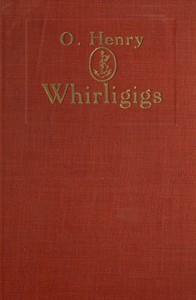
Whirligigs — A Reader’s Guide
(0 User reviews)
1015
Project Gutenberg
1999
Not confirmed
Fiction; Short stories, American
Readers of public-domain and historical texts
Project Gutenberg digital edition
en
Edition facts
Words
80,870
Reading time
352 min
Text sections
25
Before opening Whirligigs — A Reader’s Guide, the edition data offers a quick orientation: 80,870 words, 5 hr 52 min estimated reading time, and 25 detected text sections.
The text analysis averages about 15.3 words per sentence, while the detected sections provide another way to judge how the source is divided.
Project Gutenberg metadata also associates the work with “Fiction,” connecting these edition facts with the source record’s subject description.
Source:
Project Gutenberg record #1595
O. Henry's 1910 collection 'Whirligigs' presents twenty-four stories where ironic twists and moral reckonings often hinge on a single line or gesture. The excerpts reveal a recurring structural device: a character's fate pivots on a repeated phrase or image, as in 'The Roads We Take,' where a dream sequence mirrors a Wall Street deal. The catalog subjects 'Fiction; Short stories, American' understate the collection's thematic focus on deception, class, and the mechanics of storytelling itself.
Editorial Edition Score
4.9/5
★★★★★
★★★★★
Calculated from edition completeness, EPUB availability, text structure and catalogue metadata. Not a user rating.
How this score is calculated
- Description quality20 pts
- Title & short description10 pts
- Source metadata20 pts
- Text length15 pts
- Chapters / structure15 pts
- EPUB file integrity20 pts
Total of 100 points, scaled to a 2.5-5.0 range. Editions with an empty description or a missing EPUB file are not scored.
Edition quality
Public-domain source text
Read the source text
The source text is kept in the dedicated reader, separate from this catalogue record and its commentary.
O. Henry opens 'Whirligigs' with a narrator who punctures the adage that truth is stranger than fiction, citing a policeman's line from a story as proof that fiction can be stranger still. This self-aware gambit sets the tone for a collection where narrative contrivance is both a tool and a target. The excerpts show a writer obsessed with the machinery of plot—how a single repeated phrase, like 'Bolivar cannot carry double' in 'The Roads We Take,' can bridge a Western shootout and a Wall Street corner, exposing the same cold ferocity in both settings.
Repeated Lines as Structural Hinges
In 'The Roads We Take,' the phrase 'Bolivar cannot carry double' appears first in a stagecoach robbery and later in a broker's office, spoken by the same character after a dream. The repetition is not mere echo; it forces the reader to see the moral equivalence between outlaw and financier. Similarly, 'The World and the Door' opens with a narrator who insists on the strangeness of fiction, then delivers a tale where a millionaire's party veers into a violent confrontation. O. Henry uses these verbal recurrences to bind disparate worlds—the criminal and the respectable, the real and the imagined—into a single ironic frame.
The Gambler's Descent in 'A Blackjack Bargainer'
The excerpt from 'A Blackjack Bargainer' offers a concentrated study of ruin. Yancey Goree, a lawyer turned drunkard, listens to poker chips clicking in the courthouse while he sits in his decrepit office. The path from his door to the game has cost him his inheritance, his home, and his self-respect. O. Henry renders this decline through concrete details: the creaky chair, the yellow Catawba River, the 'sheared one' denied a seat at the table. The story's title hints at a bargain, but the excerpt stops short of revealing it, leaving the reader to infer that the price has already been paid.
Catalog Subjects vs. Actual Content
The Project Gutenberg catalog lists 'Whirligigs' under 'Fiction; Short stories, American' and 'Fantasy & Juvenile Worlds,' yet the excerpts contain no fantasy or juvenile elements. Instead, they depict adult worlds of money, violence, and moral compromise. 'The Roads We Take' features a murder and a stock market squeeze; 'A Blackjack Bargainer' portrays alcoholism and social ostracism. The 'Fantasy' tag may derive from the collection's title—a whirligig is a spinning toy—but the stories themselves are grounded in realistic, often gritty, settings. Readers expecting whimsy will find instead a hard-edged irony that questions the very nature of storytelling.
These excerpts suggest that 'Whirligigs' rewards attention to repeated motifs and structural parallels. O. Henry's narrators frequently interrupt to comment on the act of telling, reminding us that every story is a constructed whirligig—spinning, deceptive, and liable to stop at an unexpected point. Readers may wish to track how each story's title relates to its internal mechanism, and whether the promised 'whirligig' of fate delivers the ironic justice O. Henry is known for.
That rainy afternoon, I kept returning to “The Roads We Take,” marveling at how a single repeated phrase could tilt a life sideways. Whirligigs felt like that—fate turning on a syllable. Later, half-asleep, I found myself remembering another old puzzle where a choice behind a door decides everything, and I opened The Lady, or the Tiger? — Background and Themes almost without thinking. The rain never stopped. Neither did the wondering.
There are no reviews for this eBook.
There are no comments for this eBook.
Reader reflection
Take a moment to reflect on this book
Create a short personal record of your experience with this book.
Your progress
0
/
10
2
What was your overall reaction to the book?
3
Would you recommend this book to another reader?
4
How demanding did the text feel?
5
Was the book easy to understand?
6
Would you read this book again?
7
Did this book create an emotional response?
8
How did the pace of the book feel?
9
What did this book teach you most?
10