1

It, and Other Stories — Key Ideas to Explore
(0 User reviews)
1305
Project Gutenberg
2009
Not confirmed
Fiction; Short stories
Readers of public-domain and historical texts
Project Gutenberg digital edition
en
Edition facts
Words
85,511
Reading time
372 min
Text sections
8
This digital edition of It, and Other Stories — Key Ideas to Explore is described by source-level measurements including 85,511 words, 6 hr 12 min estimated reading time, and 8 detected text sections.
The text analysis averages about 15.8 words per sentence, while the detected sections provide another way to judge how the source is divided.
Project Gutenberg metadata also associates the work with “Fiction,” connecting these edition facts with the source record’s subject description.
Source:
Project Gutenberg record #27934
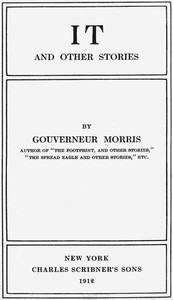
Gouverneur Morris's 1912 collection of adventure and picaresque stories, characterized by vivid sensory details, ironic narration, and sharp dialogue. Excerpts reveal a preference for exotic settings, morally ambiguous characters, and a distinctive blend of humor and violence.
Editorial Edition Score
4.7/5
★★★★★
★★★★★
Calculated from edition completeness, EPUB availability, text structure and catalogue metadata. Not a user rating.
How this score is calculated
- Description quality20 pts
- Title & short description10 pts
- Source metadata20 pts
- Text length15 pts
- Chapters / structure15 pts
- EPUB file integrity20 pts
Total of 100 points, scaled to a 2.5-5.0 range. Editions with an empty description or a missing EPUB file are not scored.
Edition quality
Public-domain source text
Read the source text
The source text is kept in the dedicated reader, separate from this catalogue record and its commentary.
Gouverneur Morris opens his 1912 collection with a dedicatory poem that sets a self-deprecating, commercial tone: “These are Bread-and-Butter stories.” The first story, “It,” immediately plunges the reader into a vividly described tropical beach, where the narrator wades ashore past a grounded shark that “made a noise like a pig.” Morris’s prose is dense with sensory detail—the “bloody murder victim” sunset, the “crazy-quilt” sail of patchwork materials—and his narrator’s voice is wry and world-weary, undercutting the adventure with ironic asides. The excerpts suggest a writer who values atmosphere and character over plot mechanics, often letting a scene’s texture carry the narrative.
Diction and the Texture of Place
Morris’s word choices anchor his settings in the physical and the strange. In “It,” the beach is defined by a “half circle of the deadliest, double-damned, orchid-haunted black morass,” where insects form a “solid wall.” The canoe is described not by its function but by its materials: “satinwood,” “scrap-iron, rotten ivory, and ebony.” Such cataloging gives objects a tactile weight. The narrator’s voice mixes colloquial bluntness (“Not nice, it wasn’t”) with literary precision, creating a persona that is both rough and observant. Even the shark’s pig-like noise grounds the exotic in the familiar, a technique Morris repeats to make the improbable feel immediate.
Dialogue as a Tool of Power and Tension
In “The Bride’s Dead,” dialogue drives the standoff between Farallone and the bride. Their exchanges are clipped and charged: “We shall see,” she says; “This is a sight for gods—not jackasses,” he retorts. The bride’s commands—“Do as you’re told”—and Farallone’s echoing “will do as he’s told” create a rhythm of dominance and submission. The final line, “Not till I have buried my dead,” spoken after four shots, is stark and ritualistic. Morris uses dialogue not to explain motives but to reveal character through action and restraint, leaving the reader to infer the emotional stakes from what is left unsaid.
Narrative Voice and Ironic Distance
The first-person narrator in “It” maintains a detached, almost sardonic tone even in danger: “I landed on Prana Beach because I’d heard—but it wasn’t so and it doesn’t matter.” This shrug undercuts the adventure genre’s earnestness. In “Holding Hands,” the third-person narrator adopts a gossipy, observational style, noting how “pairs or trios” of people catch glimpses of the mysterious Mr. Masters through a hedge. The narration mimics social chatter: “He can’t be, or he wouldn’t be at Willcox’s.” Morris shifts between these voices across stories, but both share a willingness to let the reader observe without explicit judgment, trusting the details to carry implication.
Recurring Motifs: Skin, Blood, and the Body
Across the excerpts, Morris returns to physical vulnerability. In “It,” the narrator carries “a bit of skin in a half-pint flask,” and the red sunset makes seawater look like blood. The shark grounds itself, snout out, a grotesque image of exposure. In “The Bride’s Dead,” the bride’s “tense and high-pitched” voice and Farallone’s “eyes glorious with excitement and passion” suggest bodies under pressure. The consumptive suspicion in “Holding Hands” is dispelled by Willcox, but the image of Masters’s “thin and white” face and “closed” eyes lingers. These details hint at a preoccupation with mortality and the physical costs of adventure, though the excerpts do not reveal whether this thread resolves.
Structure and Pacing in the Excerpted Stories
Morris often builds scenes through accumulation of concrete detail before a sudden, violent turn. In “It,” the long description of the canoe and the landing is followed by the shark’s appearance and the narrator’s wading, but the story’s central action is withheld from the excerpt. In “The Bride’s Dead,” the cliff-top confrontation is paced with deliberate slowness—Farallone’s “one slow, deliberate step”—then shattered by four shots. The excerpt from “Holding Hands” is more leisurely, tracking social observation rather than plot. This variety suggests a collection that moves between modes: atmospheric setup, tense standoff, and social comedy, all held together by Morris’s consistent attention to the telling detail.
These excerpts reveal a writer who trusts his reader to infer meaning from gesture, setting, and the rhythm of speech. Morris’s stories reward attention to the physical world he builds—the weight of a canoe, the color of hair, the sound of a shot. Readers will find that the collection’s pleasures lie less in surprise endings than in the texture of each scene and the ironic, often weary voice that guides them through it.
It was the dry, acrid smell of spilled gunpowder in one of Morris’s stories that brought back my grandfather’s workshop, where old tools hung like patient ghosts. I remember sitting there, turning a brass compass over and over. Later, reading Homespun Tales — Edition Insights, I felt that same quiet weight of objects holding untold hours, each one a small, stubborn witness.
There are no reviews for this eBook.
There are no comments for this eBook.
Reader reflection
What was your reading experience?
Capture what you thought, learned, and would like to remember.
Your progress
0
/
10
2
How did the book work for you overall?
3
Would you recommend this book to another reader?
4
How much effort did this book require?
5
Would this book work well in a reading group?
6
Did the story or argument move comfortably?
7
Which element worked best for you?
8
Was the book what you thought it would be?
9
In one sentence, what did you learn?
10