1

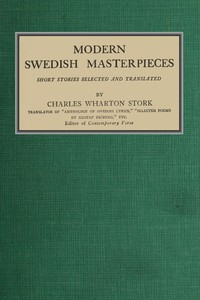
Modern Swedish Masterpieces: Short Stories — Story, Setting & Ideas
(0 User reviews)
274
Project Gutenberg
2021
Not confirmed
Short stories, Swedish -- Translations into English; Swedish fiction -- Translations into English
Readers of public-domain and historical texts
Project Gutenberg digital edition
en
Edition facts
Words
59,473
Reading time
259 min
Text sections
6
For Modern Swedish Masterpieces: Short Stories — Story, Setting & Ideas, the stored edition analysis reports 59,473 words, 4 hr 19 min estimated reading time, and 6 detected text sections.
The text analysis averages about 19.1 words per sentence, while the detected sections provide another way to judge how the source is divided.
Project Gutenberg metadata also associates the work with “Short stories, Swedish -- Translations into English,” connecting these edition facts with the source record’s subject description.
Source:
Project Gutenberg record #64808
This 1923 translation collects short fiction by four Swedish authors active around the turn of the 20th century. The excerpts show historical settings, terse dialogue, and a focus on ordinary people during wartime, with recurring motifs like wooden shoes and coat-tails serving as plot devices.
Editorial Edition Score
4.7/5
★★★★★
★★★★★
Calculated from edition completeness, EPUB availability, text structure and catalogue metadata. Not a user rating.
How this score is calculated
- Description quality20 pts
- Title & short description10 pts
- Source metadata20 pts
- Text length15 pts
- Chapters / structure15 pts
- EPUB file integrity20 pts
Total of 100 points, scaled to a 2.5-5.0 range. Editions with an empty description or a missing EPUB file are not scored.
Edition quality
Public-domain source text
Read the source text
The source text is kept in the dedicated reader, separate from this catalogue record and its commentary.
The excerpts from this 1923 translation reveal a collection that leans heavily on historical settings and terse, dialogue-driven storytelling. In the provided passage from Verner von Heidenstam's The Charles Men, the narrative follows Lena as she confronts a general about her husband Johannes's enlistment. The story uses concrete objects—a torn-off coat-tail, wooden shoes—as both evidence and symbol, grounding the drama in material detail. The prose is direct, with short sentences and minimal exposition, letting actions and spoken words carry the weight.
Objects as Evidence
The excerpt from Heidenstam's story repeatedly uses physical objects to advance the plot and reveal character. Lena presents a torn-off coat-tail as a “parson’s certificate on real sheepskin” to prove her marriage. The general accepts this improvised document, and the coat-tail later serves as proof when Lena shows it to Kerstin Bure. Wooden shoes appear as a recurring motif: the farmers march with them, and even riders have them tied to their feet, making stirrups useless. These details are not merely decorative; they function as narrative hinges. The translator, Charles Wharton Stork, preserves this concreteness, rendering the objects with plain nouns and letting their significance emerge from context rather than explanation.
Sparse Dialogue and Implied Emotion
The dialogue in the excerpt is economical and often confrontational. When Lena interrupts the general, she says, “He, Johannes here, is no serving-boy, but we have a place of our own up in the woods.” The general replies with a demand for a marriage certificate, and Lena counters with the coat-tail. The exchange is swift, with no interior monologue or authorial commentary on feelings. Later, Kerstin Bure speaks to Lena in a similarly clipped manner: “though I don’t like to see women in my service, you may as well stay with me till Johannes comes.” The emotional weight—Lena’s fear, her determination, the loneliness of winter—is conveyed through what is left unsaid. This restraint is characteristic of the Swedish short story tradition represented in the collection, as described in the translator’s preface.
War’s Impact on Rural Life
The story is set during a war (likely the Great Northern War, given the reference to Charles XII and Stenbock), but the focus is on the home front. Lena’s husband is conscripted, and the mill stands idle because “there was no meal to grind.” The able-bodied men have all run off to fight, leaving only the sexton and the idiot. The passage traces the arc from departure to return: the winter silence, the spring messenger shouting “Sweden, Sweden was saved,” and finally the homecoming army with “bag-pipes and shawms.” The narrative does not glorify the war; instead, it registers its cost through the empty mill and the women who wait. The translator’s preface notes that these chapters from The Charles Men can stand alone, and this excerpt demonstrates how they function as self-contained stories about ordinary people caught in historical events.
Readers approaching this collection should attend to the physical details and the gaps in dialogue, as the authors often convey meaning through what is shown rather than told. The translator’s preface indicates that these stories represent a range of Swedish writers active in the early 1900s, and the excerpts suggest a shared interest in historical settings and understated emotion. The catalog subjects list the book as adventure and picaresque fiction, but the actual prose is more restrained than those labels might imply.
There’s a particular ache in those Swedish stories—the wooden shoes, the coat-tails, the plain talk around wartime tables. I found myself carrying that quiet weight afterward, and it led me to something much like it, only softer around the edges: Northern Lights, Volume 5. — Background and Themes. It felt less like reading onward and more like sitting with the same weather, a little longer than I’d planned.
There are no reviews for this eBook.
There are no comments for this eBook.
Reader reflection
Take a moment to reflect on this book
Create a short personal record of your experience with this book.
Your progress
0
/
10
2
Was reading this book enjoyable?
3
Would you encourage someone else to read it?
4
What was the reading difficulty like?
5
Which aspect of the book did you value most?
6
Did the book give you something worth debating?
7
Did this book create an emotional response?
8
How closely did the book connect with your experience?
9
What is the main idea you are taking away?
10