
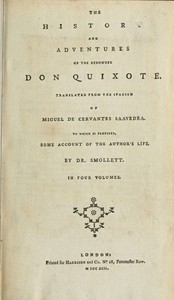
The history and adventures of the renowned Don Quixote by Cervantes Saavedra
Imagine you're so obsessed with fantasy books that you decide to become a knight and go on adventures. That's exactly what happens to Alonso Quixano, a country gentleman who's read one too many chivalry novels. He dubs himself Don Quixote de la Mancha, puts on a rusty suit of armor, and recruits a farmer named Sancho Panza as his squire. Together they roam the Spanish countryside, with Quixote seeing epic battles and noble quests where there are only windmills, sheep, and ordinary people. Sancho, hoping for the island Quixote promised to make him governor of, plays along while trying to keep his master out of too much trouble.
The Story
The book follows their misadventures in two parts. In the first, published in 1605, we meet Quixote and Sancho as they set out. Quixote attacks windmills he believes are giants, tries to free prisoners he thinks are oppressed knights, and declares a simple farm girl to be his lady love, Dulcinea del Toboso. In the second part from 1615, other characters have actually read about Quixote's adventures and play along with his delusions, sometimes cruelly. The relationship between master and squire deepens, and there's a surprising amount of meta-commentary about the first book's publication. Through it all, Cervantes keeps switching between slapstick comedy and moments of genuine wisdom.
Why You Should Read It
Here's the thing—this isn't just a funny story about a crazy old man. It's about how stories shape our reality. Quixote isn't stupid; he's chosen to see the world as more magical than it is. His speeches about honor, love, and justice are actually beautiful. Sancho starts as a simple man looking for material gain but grows into someone who genuinely cares for Quixote. Their conversations are the heart of the book. You'll find yourself laughing at Quixote one moment, then wondering if his way of seeing things isn't somehow better than the cynical 'real' world. It's also shockingly modern in how it plays with fiction—characters discuss the first book within the second book, and Cervantes inserts himself as a narrator collecting the 'true' story.
Final Verdict
Perfect for anyone who loves character-driven stories, smart humor, or books that make you think about reality versus illusion. If you enjoy buddy stories with great dialogue, this is the original odd couple. Yes, it's long and written 400 years ago, but the Edith Grossman translation (or others) makes it read smoothly. Don't be intimidated by its 'classic' status—it's genuinely entertaining. Just be prepared to fall in love with two of literature's most unforgettable characters and maybe question your own perceptions along the way.
This digital edition is based on a public domain text. Share knowledge freely with the world.
Thomas Martinez
7 months agoI wanted to compare this perspective with traditional views, the narrative arc keeps the reader engaged while delivering factual content. Top-tier content that deserves more recognition.
Charles Martinez
1 year agoOne of the most comprehensive guides I've read this year.
Charles Williams
1 year agoHaving explored several resources on this, I find that the evidence-based approach makes it a very credible source of information. A mandatory read for anyone in this industry.
James Garcia
6 months agoUnlike many other resources I've purchased before, the wealth of information provided exceeds the average market standard. I feel much more confident in my knowledge after finishing this.


John Brown
1 year agoI particularly value the technical accuracy maintained throughout.