1

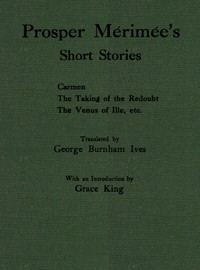
Prosper Mérimée's Short Stories — Context and Discussion
(0 User reviews)
1208
Project Gutenberg
2022
Not confirmed
Short stories, French -- Translations into English; French fiction -- Translations into English
Readers of public-domain and historical texts
Project Gutenberg digital edition
en
Edition facts
Words
46,742
Reading time
204 min
Text sections
9
Before opening Prosper Mérimée's Short Stories — Context and Discussion, the edition data offers a quick orientation: 46,742 words, 3 hr 24 min estimated reading time, and 9 detected text sections.
The text analysis averages about 17.4 words per sentence, while the detected sections provide another way to judge how the source is divided.
Project Gutenberg metadata also associates the work with “Short stories, French -- Translations into English,” connecting these edition facts with the source record’s subject description.
Source:
Project Gutenberg record #67643
This edition collects Mérimée's stories including 'Carmen' and 'The Taking of the Redoubt,' translated by George Burnham Ives. The introduction by Grace King traces Mérimée's fascination with Spanish and gypsy life, noting his precise, ironic style and the ethnographic detail woven into his fiction.
Editorial Edition Score
4.7/5
★★★★★
★★★★★
Calculated from edition completeness, EPUB availability, text structure and catalogue metadata. Not a user rating.
How this score is calculated
- Description quality20 pts
- Title & short description10 pts
- Source metadata20 pts
- Text length15 pts
- Chapters / structure15 pts
- EPUB file integrity20 pts
Total of 100 points, scaled to a 2.5-5.0 range. Editions with an empty description or a missing EPUB file are not scored.
Edition quality
Public-domain source text
Read the source text
The source text is kept in the dedicated reader, separate from this catalogue record and its commentary.
Mérimée's prose in these stories is marked by a deliberate, almost reportorial detachment that belies the violent or passionate events he describes. In the introduction, Grace King observes that his imagination was drawn to 'the passionate drama of Spain,' and the excerpts bear this out: a gypsy woman's trick on a love-lorn lady is recounted with cool precision, the narrator noting the exact coins sewn into a handkerchief. This clinical eye extends to the author's own ethnographic footnotes, where he dissects gypsy dialects and customs with the same dispassion he applies to a bandit's exploits.
The translation by George Burnham Ives preserves Mérimée's characteristic economy—sentences are lean, dialogue is sparse but pointed, and descriptive passages serve double duty as character revelation. Readers will find a writer who trusts his material to speak for itself, rarely editorializing, and who embeds his most telling observations in offhand remarks or parenthetical asides.
A Narrator Who Observes, Not Judges
Mérimée's narrators often position themselves as witnesses rather than participants. In the excerpt concerning the gypsy's swindle, the narrator recounts the event without moral outrage: 'I leave you to guess whether the poor love-lorn creature saw her handkerchief or her faithless lover again.' The tone is wry, almost clinical. This narrative stance recurs throughout the collection; even when describing violence or deception, Mérimée maintains a cool distance that forces the reader to supply the emotional response.
King's introduction notes that Mérimée's first work, The Plays of Clara Gazul, was so vivid an imitation of Spanish drama that it 'mystified the critics.' This early facility for mimicry suggests a writer who preferred to observe and reproduce rather than to moralize. The reader should attend to what the narrator does not say—the gaps and silences are as telling as the reported facts.
Ethnographic Detail as Narrative Engine
Mérimée embeds substantial ethnographic material into his fiction, but he does so with a light touch. The long passage on gypsy origins—tracing the rommani language to Sanskrit, listing Greek loanwords like cocal (bone) and petalli (horseshoe)—is presented as a footnote or aside, yet it serves to authenticate the world of the story. The gypsy's own anecdote about the smoking stove, with its punchline delivered in 'good German,' reveals both cultural pride and a sardonic view of the 'Gentiles.'
This layering of fact within fiction gives Mérimée's stories a documentary quality. He does not simply tell us that gypsies are cunning; he shows them in action and then provides a scholarly gloss on their language and customs. The effect is to make the exotic seem ordinary, and the ordinary strange.
Dialogue That Reveals Character Through Indirection
Mérimée's dialogue is economical and often ironic. The gypsy woman's instructions for the handkerchief spell are given in precise, almost bureaucratic detail: 'Now sew a piastre into a corner of it, with crimson silk; half a piastre into another; a piecette here; a two real piece here.' The specificity of the coins and colors creates a sense of ritual, but the reader quickly realizes it is a con. The gypsy's later boast to the narrator—'The Gentiles are such fools'—is delivered with a shrug, not malice.
This technique extends to the stories not excerpted here. Mérimée rarely lets characters explain themselves; instead, their words and actions are left to accumulate meaning. The reader must piece together motive from what is said and, more importantly, from what is left unsaid.
The Role of the Translator and the Introduction
George Burnham Ives's translation, first published in 1903, aims for a natural English idiom while preserving Mérimée's concision. The sentences are shorter than in many Victorian translations, and the dialogue retains a colloquial edge. Grace King's introduction, written for this edition, provides a contemporary (1903) perspective on Mérimée's reputation, noting that his stories 'shine like a constellation in French literature.' King emphasizes Mérimée's 'extreme susceptibility to exotic influences' and his lifelong fascination with Spain, which she traces from his early literary hoax to his travels in 1830.
King's essay is itself a period piece—its florid praise ('charm as attractive as ever, and inexplicable, as charm must be') contrasts with Mérimée's own spare style. Readers may find it useful to read the introduction after the stories, to see how one early critic framed a writer who defied easy categorization.
These stories reward a slow reading. Mérimée's sentences are dense with implication, and his narrators are unreliable in their very reliability—they tell us exactly what happened, but never quite what it means. Pay attention to the details that seem extraneous: the exact number of coins, the etymology of a word, the offhand remark of a minor character. In Mérimée's world, these are the clues to the real story, the one the narrator does not bother to explain.
Mérimée’s characters, even in the redoubt’s smoke, kept a certain dry dignity, a gypsy’s sideways glance at fate. I often think that spirit lingers in the short pieces gathered elsewhere, where life’s little jokes arrive with the same unhurried, ironic patience. It is a quiet kinship. Whirligigs — A Reader’s Guide rests beside that old volume on my shelf, nodding to it across the years.
There are no reviews for this eBook.
There are no comments for this eBook.
Reader reflection
Take a moment to reflect on this book
Create a short personal record of your experience with this book.
Your progress
0
/
10
2
Was reading this book enjoyable?
3
Would you encourage someone else to read it?
4
What was the reading difficulty like?
5
Did the book give you something worth debating?
6
Could you follow the author’s main argument?
7
What did you think about the pace?
8
Did this book create an emotional response?
9
What changed or sharpened your thinking?
10